

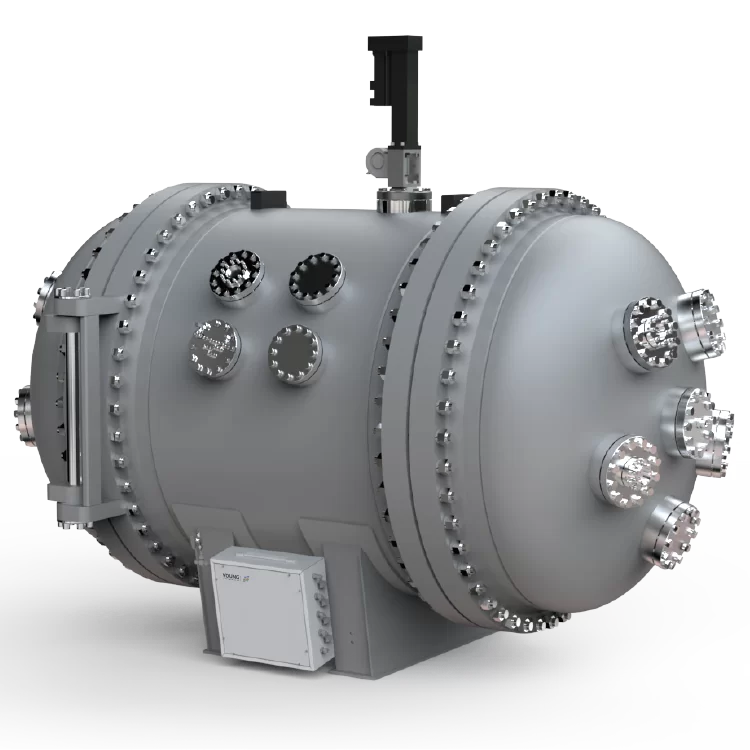
Features
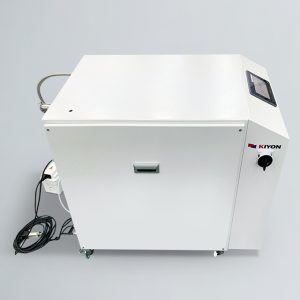
| The 1,000 mm diameter furnace provides sufficient testing space for large-format prismatic cells, battery modules, and structural battery assemblies, supporting comprehensive thermal evaluation at the module level. | With a self-exothermic detection sensitivity of 0.01–0.02 °C/min, the system accurately captures the early stages of self-heating and identifies the onset of thermal runaway. |
| Supporting currents of up to ±1,000 A, the BAC-1000AE enables high-power charge/discharge testing, heat generation analysis, and severe electrical abuse testing under realistic operating conditions. | The integrated auxiliary heating wire helps establish and stabilize the required thermal baseline, while reducing preparation time and improving overall testing efficiency. |
| The system combines adiabatic thermal runaway testing with gas generation analysis, enabling simultaneous monitoring of temperature rise, gas volume, and pressure changes throughout the test. | Multiple safety mechanisms, including bursting discs, pressure relief valves, and multi-level alarm systems, provide enhanced protection during high-energy battery module testing. |
Specifications
| Adiabatic Furnace Dimensions | 1000 mm (Diameter) × 1200 mm (Depth) |
| Self-exothermic Detection Sensitivity | 0.01–0.02 ℃/min, adjustable via software |
| Temperature Difference between Furnace and Sample in Constant Temperature | ≤1 °C |
| Temperature Control Range | RT – 300 °C, with a low-temperature module reaching -25 °C |
| Sealed Canister Pressure Range | 0–2 MPa |
| Temperature Tracking Rate | 0.02–15 °C/min |
| Maximum Nail Penetration Stroke | Up to 200 mm (through software settings) |
| Maximum Current-carrying Capacity of Charge/Discharge Electrode Posts | -1000–1000 A |
Applications
- Testing for Explosion Limits of Gases from Lithium-Ion Battery Thermal Runaway
- Adiabatic Thermal Runaway Characteristics Study of Large-Capacity High-Nickel Lithium-Ion Batteries
- Thermal Runaway Behavior of Ni-Rich NCM 9-Series Lithium-Ion Batteries
- Comparison of Isothermal Calorimeter and Battery Adiabatic Calorimeter for Lithium Battery Charge/Discharge Heat Production Measurement
- Optimized Protocol for Heating Wire-Assisted Temperature Difference Baseline Experiments
- Verification of the Impact of Clamp Types on the Thermal Runaway Test Results of HWS Batteries