

Features
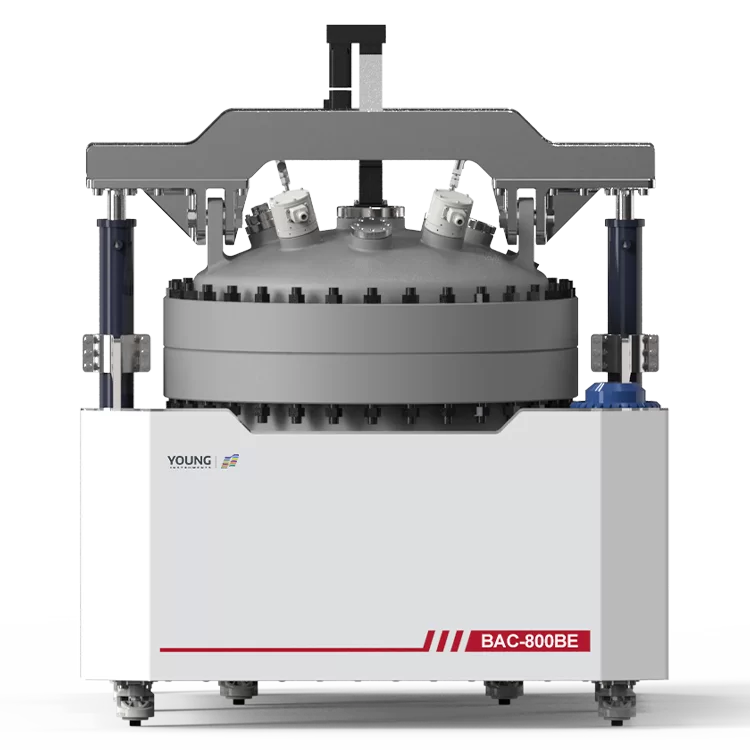
| ±1000 A High-Power Electrical Abuse Capability | High Sensitivity Self-Heating Detection |
| 800 mm Furnace for Large Cells and Modules | Auxiliary Heating Wire Acceleration |
| Adiabatic Runaway & Gas Pressure Coupled Analysis | Enhanced Pressure Safety System |
Specifications
| Adiabatic Furnace Dimensions | 800 mm (Diameter) × 520 mm (Depth) |
| Self-exothermic Detection Sensitivity | 0.01–0.02 ℃/min, adjustable via software |
| Temperature Difference between Furnace and Sample in Constant Temperature | ≤1 °C |
| Temperature Control Range | RT–300 °C, with a low-temperature module reaching -25 °C |
| Temperature Tracking Rate | 0.02–15 °C/min |
| Sealed Canister Pressure Range | 0–2 MPa |
| Maximum Nail Penetration Stroke | Up to 200 mm (through software settings) |
| Maximum Current-carrying Capacity of Charge/Discharge Electrode Posts | -1000–1000 A |
Applications
| Testing for Explosion Limits of Gases from Lithium-Ion Battery Thermal Runaway | Comparison of Isothermal Calorimeter and Battery Adiabatic Calorimeter for Lithium Battery Charge/Discharge Heat Production Measurement |
| Adiabatic Thermal Runaway Characteristics Study of Large-Capacity High-Nickel Lithium-Ion Batteries | Optimized Protocol for Heating Wire-Assisted Temperature Difference Baseline Experiments |
| Thermal Runaway Behavior of Ni-Rich NCM 9-Series Lithium-Ion Batteries | Verification of the Impact of Clamp Types on the Thermal Runaway Test Results of HWS Batteries |