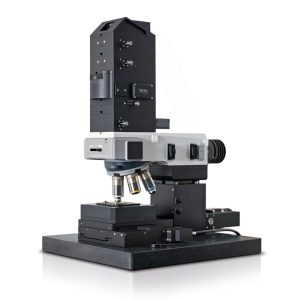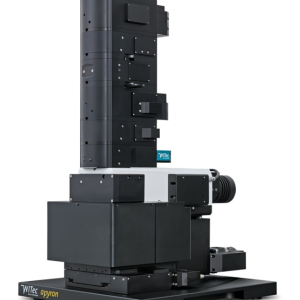


MODEL: FX40
The FX-series AFMs are designed for minimal mechanical noise. The optical microscope is decoupled from the Z stage, lowering the weight on the Z stage and thus reducing susceptibility to mechanical disturbances. The Z stage itself is built more robustly with a high-stiffness cross-roller guide and two bearing blocks.
Constructed with materials of low thermal expansion coefficients mitigates thermal drift, the FX40 delivers reliable performance over time.
FX Laser Beam Path
The FX optics structure integrates a fiber-coupled laser (superluminescent diode; SLD) into the optical microscope assembly. The laser beam is focused through the objective lens and remains fixed at the center of the optical field of view.

Automatic Laser Beam Alignment

Automatic Probe Exchange

Each chip carrier is marked with a QR code containing detailed information, including probe type, serial number, date manufactured, and specifications.
The FX head’s Z scanner features three precision ball seats for kinematic mounting, complemented by magnets at the base to ensure a secure, reliable, and repeatable mounting position.

The automatic tip exchanger (ATX) module stores up to 8 pre-mounted probes. After the ATX camera scans the probes’ QR codes, the SmartScan™ AFM operating software displays probe information for each slot, allowing the user to select full or vacant probe slots with a simple mouse click.
After a slot is selected, the AFM head moves down to pick the probe up from or park the currently mounted probe into the slot, depending on the position of the strong magnet underneath.
Sample-View Camera

Improved On-Axis Optics

Orthogonal Scan System
Conventional AFMs with tube scanners suffer from out-of-plane motion and axes crosstalk, resulting in image distortion, especially over large scan areas. FX40, like all Park AFMs, employs an advanced orthogonal scan system featuring a flexure-guided architecture: a 2D flexure scanner moves the sample in the XY plane, while a separate 1D flexure scanner independently controls the probe’s Z-axis motion. This separated scanner system ensures highly orthogonal, linear scans with minimal out-of-plane motion and fast dynamic performance. Equipped with low-noise optical sensors for XY feedback and an ultra-low-noise strain gauge sensor for Z control, a closed-loop servo control system ensures precise and repeatable scanning across all axes.


True Non-Contact™ Mode