

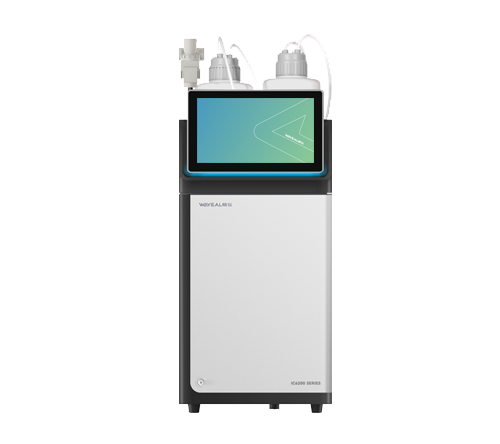
Introduction of Ion Chromatography Instrument
The IC6200 Series Intelligent Ion Chromatograph is a next-generation integrated ion chromatography system designed to deliver exceptional precision, outstanding stability, and intelligent operation for modern laboratories. Engineered to enhance analytical efficiency and laboratory productivity, the IC6200 Series combines advanced technology with a user-centric design. It features a 10-inch intelligent touchscreen that provides intuitive operation and simplifies workflow management. Complementing its modern appearance, the integrated ambient lighting design enhances the user experience while reflecting the instrument’s premium quality. With its reliable performance and smart functionality, the IC6200 Series is an ideal solution for laboratories seeking accurate, efficient, and dependable ion chromatography analysis.
Technical Paramaters of IC6200 Ion Chromatography Instrument
| Product Name | IC6200 Ion Chromatography Instrument |
| System Parameters | |
| Qualitative repeatability | ≤1% |
| Quantitative repeatability | ≤1% |
| Pump System | |
| Pump material | PEEK |
| Pump flow rate | (0.001~12.000) mL/min |
| Pump head pressure resistance | (0 ~ 42) MPa |
| Flow rate setting inaccuracy | ≤0.2% |
| Flow stability | ≤0.2% |
| Pressure display accuracy | 0.01Mpa |
| Pressure pulsation | ≤0.3% |
| Conductivity Detector | |
| Baseline noise | ≤0.0002μS |
| Baseline drift | ≤0.0005μS/30min |
| Minimum detectable concentration (Cl–) | ≤ 0.0001μg/mL |
| Conductivity cell volume | ≤ 0.6μL |
| Conductivity detection range | 0-100000μS/cm |
| Conductivity cell temperature setting error | ±0.01°C |
| Ampere detector | |
| Type | Thin layer structure, automatic range |
| Driving voltage range | -2.048 V ~ +2.048 V |
| Drive voltage resolution | 0.001V |
| Output signal range | 50pc—200uC |
| DC mode | 1pA—74uA |
| Noise | <30pC |
| Cell material | Titanium |
| Qualitative repeatability | ≤0.1% |
| Quantitative repeatability | ≤0.5% |
| Suppressor | |
| Constant current source range | 0~500mA in 0.1mA increments |
| Column Oven | |
| Temperature range | room temperature: +5°C~85°C |
| Control temperature stability | ≤ 0.01°C |
| Autosampler | |
| AS2800 | |
| Injection Bits | 48/11 |
| Refrigeration temperature range | 4-30°C |
| Quantitative repeatability | Full loop injection < 0.5% RSD, |
| Working temperature | 10~40°C |
| AS3110 | |
| Injection Bits | 64/120 |
| Repeatability | Full loop injection: <0.3%RSD (Injection volume 5μL) |
| Linearity | >0.999 |
| Cross-contamination | <0.01% |
System configuration of IC6200 Ion Chromatography Instrument
Pump: Full PEEK pump head, resistant to acids, alkalis and reversed-phase organic solvents.
Detector: Conductivity detector, UV detector and Amperometric detector are optional, with high sensitivity to detect ion concentration.
Column: self-developed anion and cation chromatographic columns, guard columns, for the separation of different ions.
Suppressor: Electrolyte auto-regeneration membrane suppressor, reduces background conductivity, increases detection sensitivity, reagent-free.
Software: SmarLab Chromatography Data System for instrument control, data acquisition and analysis.
Applications of Ion Chromatography Instrument in the Food Industry
Ion chromatography (IC) is a powerful analytical technique widely used across various industries for the separation, identification, and quantification of ionic species. Below is an overview of its applications in different industries along with typical system configurations tailored to specific needs:
Additives: Determine the content of sweeteners (saccharin sodium, acesulfame, etc.), preservatives (benzoic acid, sorbic acid, etc.), antioxidants (sulfites, etc.) in food to ensure food safety.
Nutritional Analysis: Determine the content of mineral elements (Na, K, Ca, Mg, Fe, Zn, etc.) in food to evaluate the nutritional value of food.
Pesticide Residue Detection: Detect pesticide residues such as organophosphorus and organochlorine in food to ensure food safety.
Contaminant Detection: Analysis of trace-level contaminants such as perchlorate, nitrite, and bromate in drinking water and food.
Quality Assurance: Monitoring of organic acids (e.g., acetic, citric) and preservatives in beverages.