

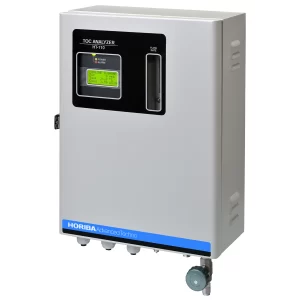
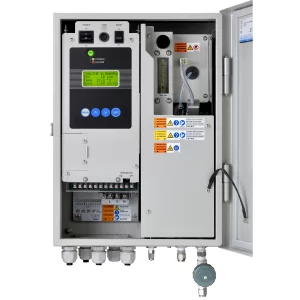
ON-LINE TOC ANALYZER – HT-110 – HORIBA
KEY FEATURES:
Adoption of UV Oxidation Conductivity Method:
The UV oxidation conductivity method, which eliminates the need for reagents and carrier gases (purge gas), has been adopted. This method allows for high repeatability of ±2% F.S. for low-concentration ranges such as water for injection (WFI) at full scale while simultaneously providing a potential reduction in operating expenses.
Suppression of Erroneous Indications Caused by Air Bubble Inclusion:
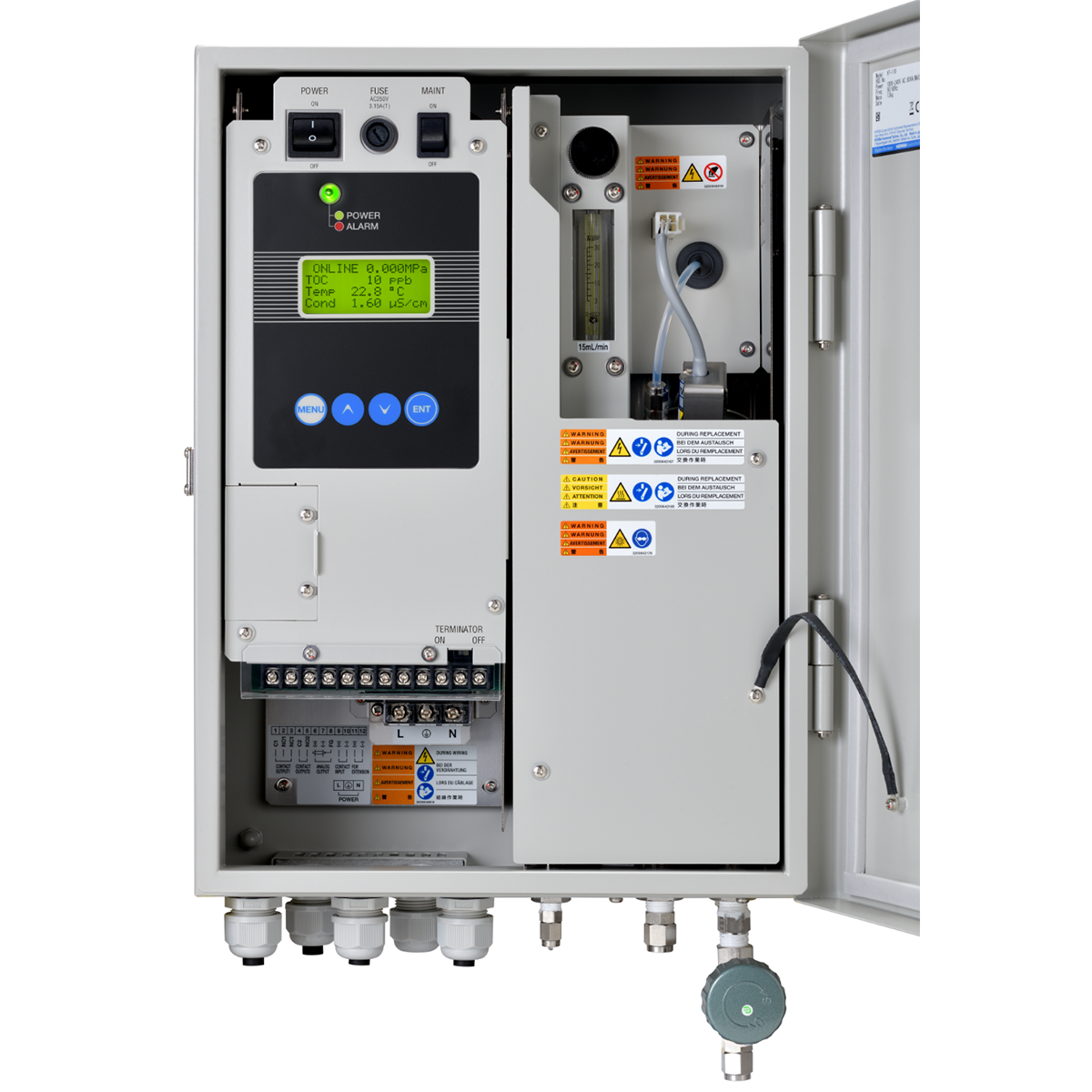
The equipment has a deaeration mechanism, which suppresses erroneous indications caused by the inclusion of air bubbles.
External control functions:
By equipping contact input terminals, it is now possible to perform ON/OFF controls externally. Useful for situations such as false alarms during SIP cleaning or nighttime shutdown of purified water equipment.
Maintenance cycle of one year:
By significantly extending the lifespan of the UV lamp, maintenance is now reduced to a single annual calibration, allowing a maintenance-free period of one year.
Compatible with USP<643>, EP<2.2.44>, JP<G8.4.5.2>:
Suitable for TOTAL ORGANIC CARBON measurement according to USP <643>, EP <2.2.44>, and for the suitability testing of “HIGHLY PURIFIED WATER”, “WATER FOR INJECTION”, and “WATER, PURIFIED” as per EP requirements. It is also ideal for the physicochemical monitoring specified in JP <G8.4.5.2> for PW (Purified Water) and WFI (Water for Injection).
Versatile installation options:
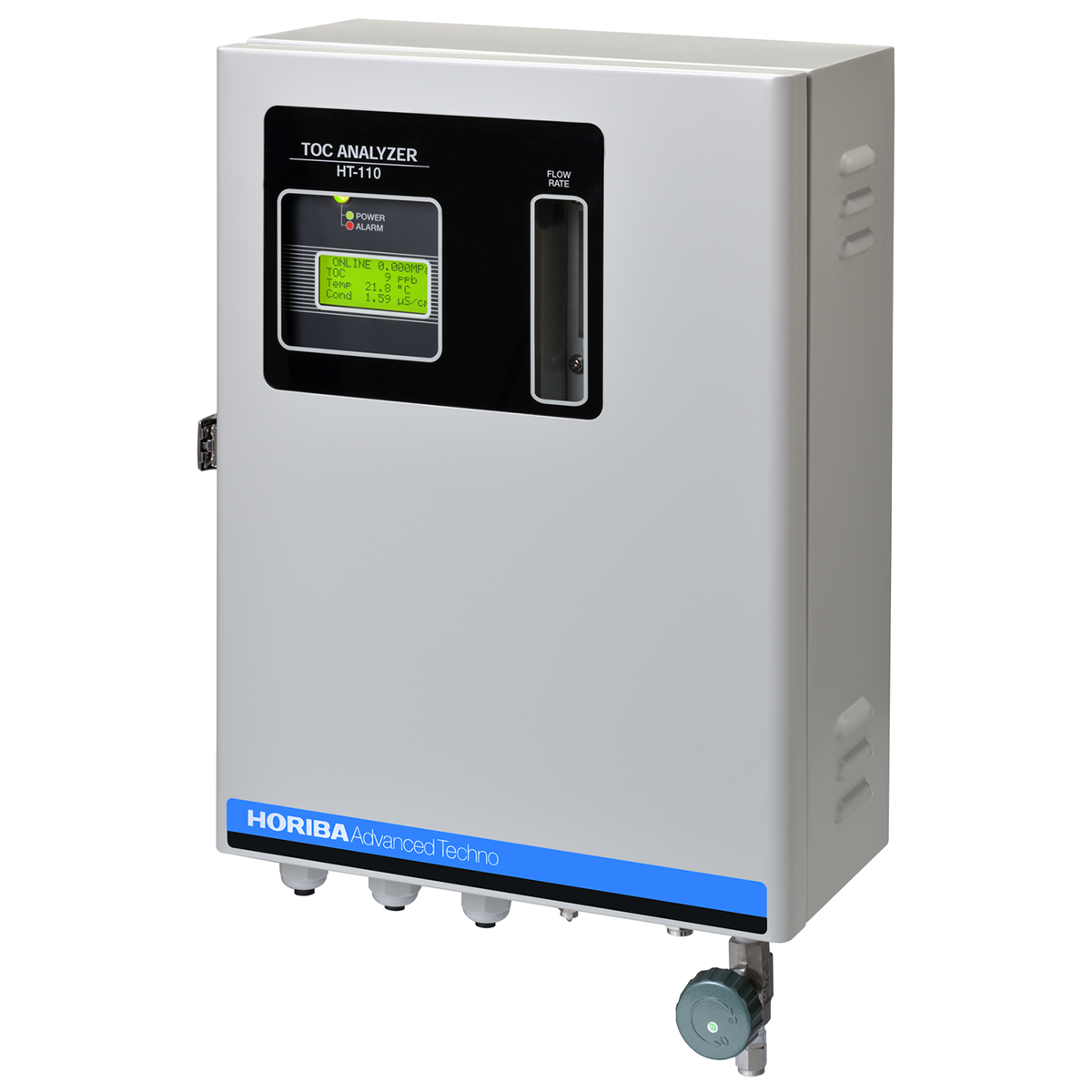
The installation methods include pole-mounts, wall-mounts, and tabletops, allowing for flexible installation options tailored to the specific site requirements for versatile installations without limitations.
SPECIFICATIONS:
| Measurement method | Continuous UV oxidation conductivity method |
| Measurement limit | 0ppb to 1000ppb |
| Measurement range | 0ppb to 100/500/1000ppb |
| Repeatability | Within ±2% of full scale |
| Display resolution | 0.1ppb (0ppb to 100ppb/0ppb to 500 ppb range)
1ppb (0ppb to 1000ppb range) |
| Transmission output | Number of output point: one
4 mA to 20 mA DC/0 V to 1 V DC (optional) insulated input/output Maximum load resistance: 600 Ω (minimum load resistance 100 kΩ (when optionally selected)) Transmission output range: optional setting possible within measurement range Output target: TOC concentration |
| Contact output | Number of outputs: 2
Alarm contact output (RLY1) Contact method: relay contact, SPDT (1c) Contact capacity: 125 V 3 A AC/24 V 3 A DC (load resistance) Contact function: upper/lower limit function (ON/OFF control) Output target: at TOC, temperature, conductivity: C-NO contact is “closed” during operation, “open” during normal conditions (including a POWER OFF state) *C-NO contact is reversed at hold, or error: C-NO contact is “open” during operation (including a POWER OFF state), “closed” during normal conditions *C-NO contact is reversed
Alarm contact output (RLY2) Contact method: relay contact, SPST (1a) Contact capacity: 125 V 3 A AC/24 V 3 A DC (load resistance) Contact function: upper/lower limit function (ON/OFF control) Output target: TOC concentration |
| Contact input | Number of input point: 1
Non-voltage normal open (1a) signal input (open collector input possible) Insulation-type input Max. ON resistance: 50 Ω Open-circuit voltage: 5 V DC Max. short circuit current: 10 mA An error will not be generated even if there is notification of no sample detection immediately after receipt of the pure water device stop signal receiving The hold operation during the contact input receiving. |
| Sample water condition | – Conductivity: less than 10μS/cm (less than 2μS/cm in 0ppb to 100ppb range)
– Temperature: 5℃ to 99℃ – Pressure: 0.03 MPa to 0.50 MPa, Pressure fluctuation: within ±0.05 MPa (within the specified pressure range) – Flow rate: 20mL/min to 200mL/min |
| Environmental conditions | – Temperature: 5℃ to 40℃
– Relative humidity: less than 85% |
| Installation | – Install place: indoor |
| Display function | LCD (with a back light) TOC, conductivity, water temperature, alarm |
| Power | 100 V to 240 V AC ±10%, 50 Hz/60 Hz built-in fuse 250 V AC 3.15 A (T) |
| Power consumption | 80 VA (max.) |
| Outside dimension | 300 (W) × 400 (H) × 165 (D) mm |
| Mass | 13kg |
| Concerned directives | – CE marking
EMC Directive: EN61326-2-3 Low Voltage Directive: EN61010-1 RoHS Directive: EN50581 – FCC rules FCC parts 15 |
| Protection structure | IP 43 (IEC60529, JIS C0920)
Pollution level 2 (IEC61010-1) |